
Custom Sew On Patches
Sew-on patches with a clean stitching edge for permanent attachment. The most durable backing available, and the only option for leather and technical fabrics.
- No Minimum Order
- Free Digital Proof
- Ships Across the USA
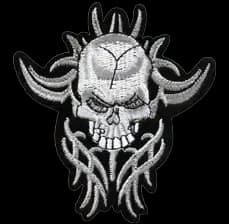
in the USA
About Custom Sew On Patches
Sew-on is the oldest way to attach a patch and still the most reliable. There is no adhesive to fail, no hook-and-loop to flatten, and no fabric type it refuses to work with. A stitched patch stays on through years of washing, weather, and hard wear, and when the garment finally wears out the patch can usually be unpicked and moved to a new one.
Key Features
- Permanent attachment
- Clean edges
- All fabric types
- Most durable option
- Traditional styling
- Custom Patches Since 2010
- No Minimum Order
- Free Digital Proof
- Unlimited Revisions
- Shipped to All 50 States
- 4.9/5 from 500+ Reviews
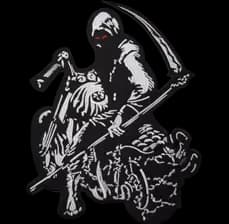
When sew-on is the only sensible choice
Leather cannot be ironed, so heat seal is out and sew-on is the answer. Technical and waterproof shells melt under an iron, though stitching them punches through the membrane, so velcro is usually better there. Anything large — a back panel, a big chest logo — carries too much weight for adhesive alone. Garments washed at high temperature every week, like workwear and chef whites, will eventually lift a heat-sealed patch but not a stitched one. And if a patch has to survive being moved to a replacement garment later, only stitching lets you unpick it cleanly.
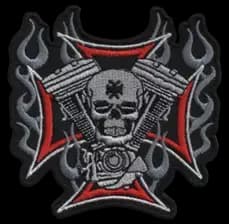
How the edge is built for stitching
A sew-on patch is finished with either a merrowed border — a thick overlocked edge that gives the needle something solid to pass through — or a laser-cut edge sealed by heat. Merrowed is the more traditional and more forgiving of the two: the raised edge hides slight inconsistencies in hand stitching and will not fray if a stitch is caught. Laser-cut allows complex outlines that merrowing cannot follow, and it sits flatter against the garment. For a patch someone will stitch on at home, merrowed is easier to work with.

Attaching it well
Pin or tack the patch in place first and check the position in a mirror before committing — a stitched patch is far harder to reposition than an ironed one. Use a thread that matches the patch border rather than the garment, so stitches disappear into the edge. A simple running stitch around the perimeter, roughly 3mm in from the edge, is enough for most patches; a whip stitch over the border is stronger and traditional on club colours. On thick leather, a machine with a leather needle or a professional alterations service will do a better job than hand stitching. Many customers order heat-seal backing as well, iron the patch on to hold the position, then stitch it — the adhesive acts as a pin.
Who orders sew on patches
- Leather vests and jackets
- Workwear and uniforms washed at high temperature
- Large back patches and chest panels
- Club colours and heirloom garments
- Scout, cadet, and school badges
Custom Sew On Patches specifications
| Specification | Details |
|---|---|
| Attachment | Hand or machine stitching |
| Border | Merrowed or laser-cut |
| Suitable fabrics | All, including leather and heavy canvas |
| Durability | Highest of all backing types |
| Minimum order | None — order any quantity |
| Standard turnaround | 20 to 30 days after proof approval |
Custom Sew On Patches Questions
What people ask us before ordering sew on patches
Ready to Order Your Sew On Patches?
Get started with a free quote today. Our team is ready to bring your design to life.